Today, GARE is a dynamic peer-to-peer learning and practice membership network of 300+ local, regional, state jurisdictions – and thousands of everyday racial equity practitioners – dedicated to advancing racial equity in government, so that we all thrive where we live, learn, work and play – no matter our race, class or zip code.
Yet, GARE as a national network grew from humble and entrepreneurial beginnings following the groundbreaking work at Race and Social Justice Initiative in the City of Seattle (RSJI). RSJI strategically “embeds racial equity and social justice principles, practices and tools, into the City’s programs, budgets, and culture.” RSJI is an exemplary organizational change model that hinges on tipping point theory, or as Glenn Harris, former Race and Social Justice Initiative Manager in the City of Seattle, and GARE co-founder put it, “Could we get a couple thousand government employees to make racial equity a daily practice? And if we could, then the entire City could adopt it.”
john powell, director of the Othering and Belonging Institute at the University of California, Berkeley, was an early supporter of Julie and Glenn’s work at the City of Seattle, and was also a co-founder of GARE. john’s personal and organizational commitment provided an essential first home for GARE when most other organizations were hesitant to talk about race.
As Julie Nelson, GARE Co-Founder, and former Director of the Office of Civil Rights in the City of Seattle recounts, “People would always be reaching out, asking us “what are you doing?” Tell us how you’re doing it. [We] kept getting these random phone calls, and I kept track of them.”
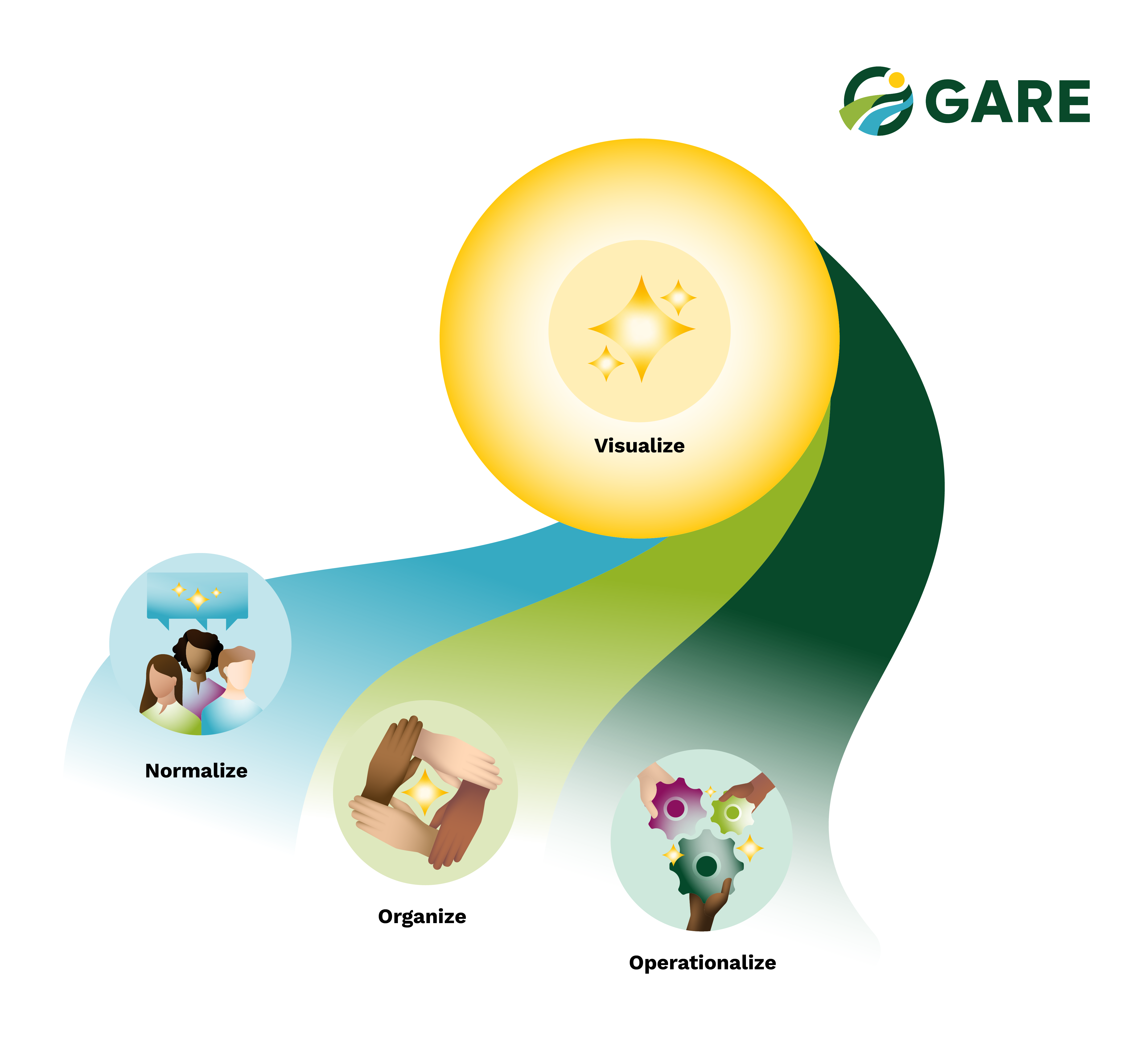
Organizational change is rarely linear - yet values-directed transformation tends to happen in a direction. Early practitioners and adopters began developing what would become the GARE Approach (also known as VNOO): Shared Vision, Shared Understanding (Normalizing), Shared Relationships (Organizing), Shared Tools (Operationalizing), as described in one of GARE’s earliest resources, Advancing Racial Equity and Transforming Government.
By 2014, “early adopters,” of the GARE Approach emerged with 37 racial equity practitioners working across 13 local and regional governments including Seattle, WA, Fairfax County, Ramsey County, Hennepin County, Dane County, City of Madison and found common cause and interest in forming an inaugural national cohort. A budding network of relationships interested in transforming the institution of government writ large - so that all families and communities can thrive where we live, work and play.
In 2016, early adopters of the GARE Approach met for a summit in Chicago, and voted to officially form the Government Alliance on Race and Equity (GARE) – a national membership network of local, regional, state jurisdictions advancing racial equity. Early adopters of the GARE Approach elected to create a national membership network of local, regional, state jurisdictions advancing racial equity so peers within government could, as co-founder Julie Nelson, put it, “transform government from within - a new model that hadn’t been done before.”
GARE has always been the racial equity practitioners in government who initiated it, created it and continue to sustain it. GARE staff members found their early organizational homes at Othering & Belonging (formerly, the Haas Institute for a Fair and Inclusive Society) and later, the Center for Social Inclusion. Since 2017, GARE has been anchored at Race Forward, a national organization that supports communities and public institutions to achieve a just, multiracial democratic society.