Register Here
Authoritarianism is growing. Learn how research can name harm, stop violence, and support justice.
In response to the rise in authoritarianism, movement researchers are responding and fighting back across multiple methods. These methods identify how tactics of authoritarianism and fascism are deployed, such as increases in state violence, deployment of secret police, centralizing power, controlling information, and silencing dissent, amongst other repressive actions. Resistance research works to expose this repression, disrupt and prevent harm and violence, uplift liberatory solutions, and build alternatives to shift power to everyday people for intersectional racial justice.
This teach-in webinar is for movement researchers and evaluators, community organizers and advocates fighting authoritarianism and repression on the ground, racial equity practitioners, and liberation leaders in organizations and communities.
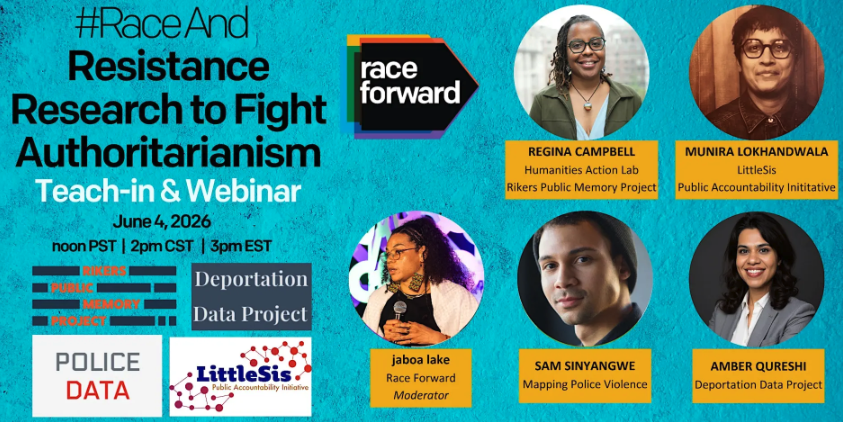
Moderator - jaboa lake
Panel
Samuel Sinyangwe is a data scientist who built Mapping Police Violence, Police Scorecard, and PoliceData.org to support activists across the country to collect and use data to fight police violence. He also co-founded Campaign Zero to advocate for local, state, and federal policy solutions to end police violence. Mr. Sinyangwe has been featured on MSNBC, CNN, BBC, NY Times, LA Times, the Forbes 30 under 30 and The Root 100. Previously, he worked at PolicyLink to support a national network of 61 communities to build cradle-to-career systems of support for low-income families. Mr. Sinyangwe grew up in Orlando, FL and graduated from Stanford University in 2012, where he studied how race and racism impact the U.S. political system.
Amber Qureshi (she/her) is a co-director of the Deportation Data Project, which obtains, posts, and analyzes internal U.S. government immigration enforcement data via public records requests. She leads the Freedom of Information Act (FOIA) requests and litigation for the project. Through her law practice, she also represents individuals and organizations in federal court on immigration and transparency issues. She has worked for many years challenging the immigration enforcement and detention systems and supported grassroots partners on local advocacy campaigns to shut down detention centers and restrict police collaboration with ICE.
Munira Lokhandwala is the Co-Executive Director at LittleSis. In her role, she focuses on the organization's mission to support grassroots organizers through power research trainings that sharpen our collective understanding of what we're up against and how to wage strong campaigns to win what our people deserve.
Regina Campbell is the Director of Oral History and Engagement for the Rikers Public Memory Project and Co-Director of the Humanities Action Lab. She provides overall project management for the Rikers Public Memory Project, where she has organized the collection of over 100 oral histories to ensure the stories of those impacted by Rikers Island Jails are preserved. Additionally, she oversees the States of Incarceration project and organizational management for the Humanities Action Lab and is a leader in the Culture of Health Leadership Institute for Racial Healing.
Regina brings extensive experience across the private, non-profit, and government sectors in organizational development and program monitoring. Her background includes four years of service leadership in Belize, where she developed educational systems for youth and creating economic opportunities for women. Upon her return to the U.S., Regina worked to break the cycle of illiteracy, poverty, and low expectations by helping families in low-income communities address the barriers to lasting success through education and career programs. Regina holds an MBA in Organizational Management from Georgia State University’s Robinson College of Business.
#EventsintheField